



(click each decade to view)
The 70's

Note:
Each picture thumbnail can then be further expand once opened.
Operational History
1971 Cruise Book
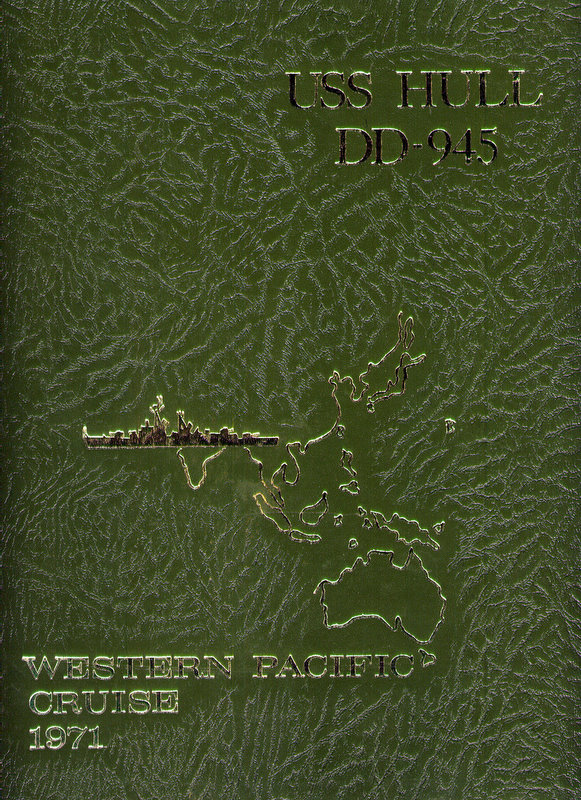 Click on book to view crew pictures
.jpg) Click on book to view crew pictures
Click on book to view crew pictures
 Click on book to view crew pictures
Combat Naval
Gunfire Support File (CONGA), [Fixed-length Version], 3/1966 - 1/1973
A record of Hull's Vietnam Gunfire Support missions
In 1971 the veteran
destroyer returned to the gun line and plane guarding on Yankee
Station.
During her 1972 Vietnam deployment, she engaged in gunfire
support, Linebacker raids, and surveillance operations.
Beginning her
eleventh WESTPAC deployment in July 1973, she traveled with the GRAY
(DE-1054), and MCCORMICK (DDG-8). Escort duty in the Gulf of Tonkin
was followed by a month of excellent typhoon evasion experience. On
her return home with the ROARK (DE-1053), the HULL picked up three
survivors from the tugboat MARPOLE, sunk by rough seas. In 1974 the
HULL gained the distinction of having the “biggest navy gun in the
world” when she became the test ship for the 8-inch 55-caliber
light-weight gun. The navy’s most heavily armed “all gun” destroyer
left for the Far East on 31 July 1976. Joined by the TOWERS (DDG-9),
the HULL steamed for Taiwan. She participated in exercises with the
Republic of China Navy and other exercises in the Philippines.
The next three
years included final tests on the 8-inch gun and eventual removal of
the big gun, which was abandoned by the navy.
(Courtesy Tin Can Sailors,
Inc. - Used with Permissio
Hullgrams
Hullgrams compliments of
shipmate Gary
Line BM3 '70-'74
(click each date to view)











Hullgrams
Hullgrams compliments of
shipmate Steve Livingston FTG3
(click each date to view)




For service during 22 Apr to
29 Oct 1972, Hull is awarded the
Meritorious Unit Citation
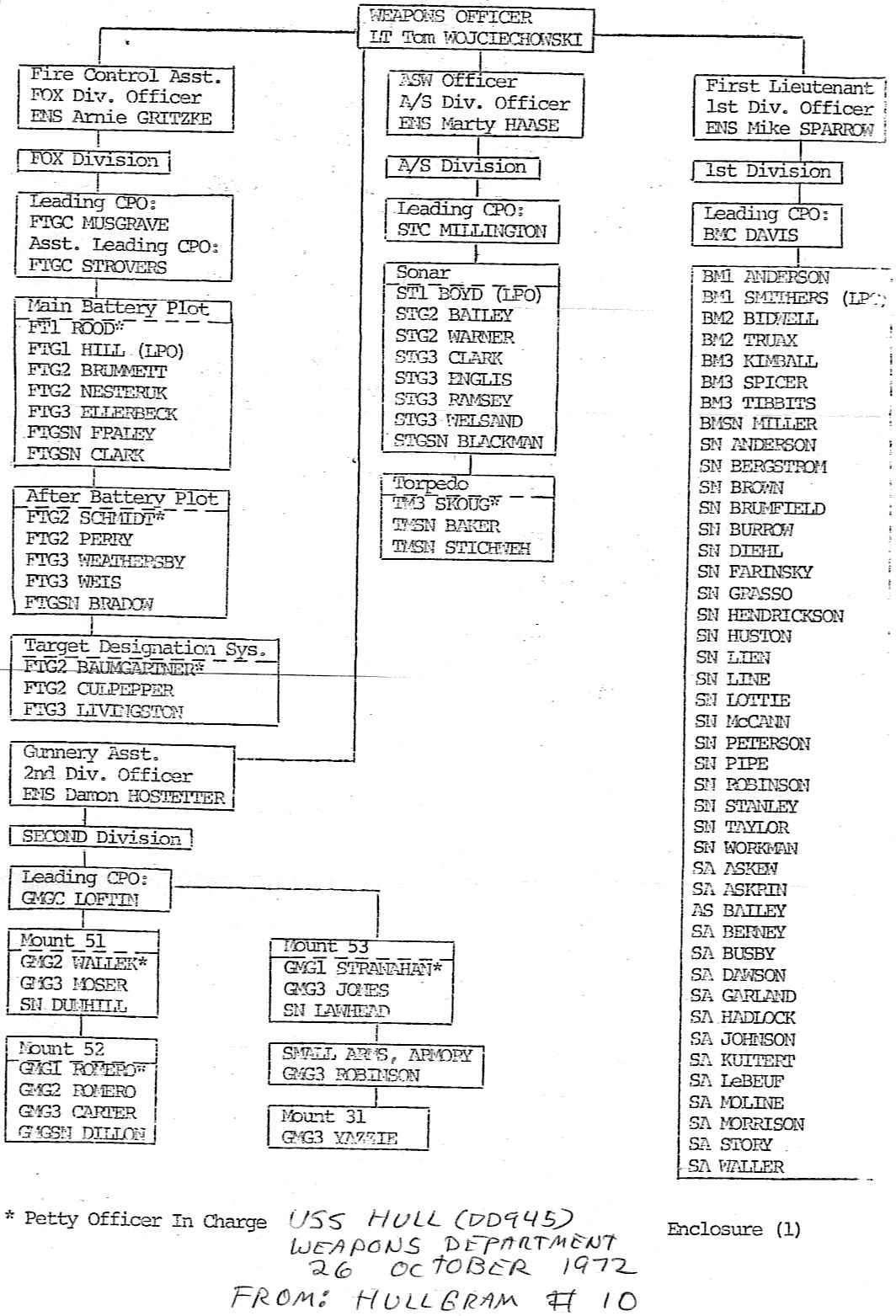
Organizational Chart (Dated 26
Oct 72) - Compliments of Steve Livingston FTG3
On 21 Jun 1973 Commander J. E. McConville
relieved Commander H. S. Quast as commanding officer.
(click to view)
Mark 71 8"-55 Major Caliber Light Weight Gun (MCLWG)
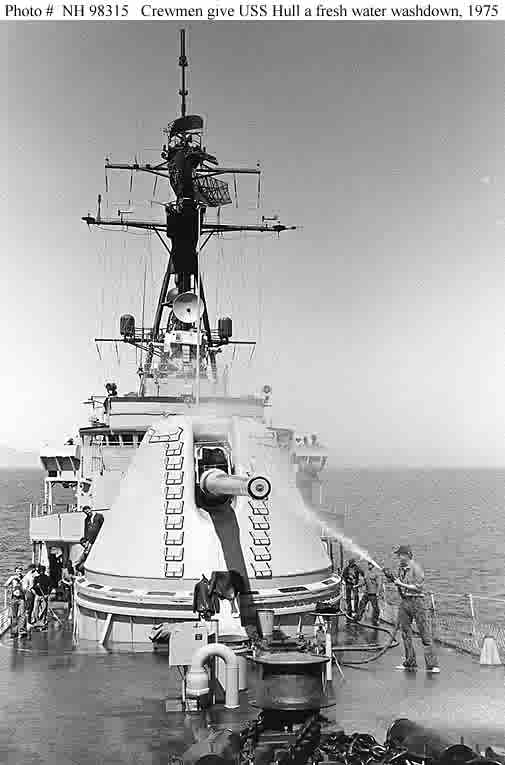
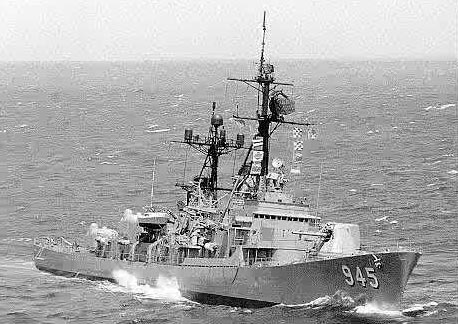
This was an attempt to produce a gun
capable of supporting amphibious landings. This gun was intended for the
Spruance destroyers and the Ticonderoga Aegis cruisers. Originally
planned to be an adaptation of the Army's 17.5 cm (6.9") but the 8" (20.3 cm)
caliber was selected during the initial evaluation testing in the early 1970's.
This gun would have combined a large explosive charge with long range and high
accuracy through laser guidance. Although the prototype was successful, the
program was cancelled as a result of budget considerations during the defense
cutbacks of the late 1970's.
The gun barrel for the Mark 71 was
the Mark 28 Mod 1, a 55 caliber two piece loose liner barrel. The production gun
mount was to have used a one piece monobloc barrel designated the Mark 32. The
chamber of this weapon was designed to be able to handle a 10-11 caliber
projectile. One of the proposed munitions was an extended range guided round
that would have been around 90 inches (229 cm) long.
As the U.S. Navy's test ship for this
weapon from 1975 to 1979, USS Hull was the only destroyer ever to
mount an 8" (20.3 cm) cannon. The mount was removed from the USS Hull in
1979 and is now at the Naval Surface Warfare Center in Dahlgren, Virginia.
For more information about the 8" gun
visit:
www.navweaps.com
Anecdotal Stories
A
couple stories by Doug Hisey MM2 '71 -'74
During my tenure on Hull we engineers managed to
avoid going truly dead in the water (DIW) …except for just once. To be sure we
had a couple of near-misses and over the course of two WESPAC’s and countless
‘local ops’ we dropped the load in either the forward or after plants, but we
only lost it ALL once (along side the pier and at anchor in Hong Kong
not-withstanding).
January 1973: Hull had dropped the In Service Inspection party at Ballast Point
and was ‘putzing’ overnight at low speed off the Coronado Strand. The propulsion
plant was cross-connected steaming on only one boiler in forward fireroom.
Through a series of seemingly unrelated events and miscommunications we had been
losing ground on our feedwater reserves for several hours (not all that unusual
in and of itself – the 1200 lb. boilers liked water almost as much as they liked
fuel). Things went from ‘concern’ to ‘crises’ just after eight PM (the movie was
playing on the mess decks) when condensate flow to the forward fireroom
deaerator ceased for all intents. For non-engineers in the audience, condensate
is water returned to the boiler(s) from the propulsion and generator turbines to
replace the water the left the boiler as steam to power the turbines in the
first place. If you can’t put water in the boilers you can’t make steam and the
‘fires’ must be pulled to avoid damaging the boiler.
Over the course of a somewhat chaotic 30 minutes or so and in-spite of the best
efforts of all engineers in the three steaming spaces – all available reserve
feedwater in the forward plant was exhausted and the forward deaerator went
‘out-of-sight-low!’ … the booster and feedwater pumps tripped and the BT’s had
no choice but to ‘pull-fires’ when water went ‘out-of-sight-low!’ in the boiler
a few moments later. It took about a minute for everything to wind down,
punctuated by the battle-lanterns finally energizing and the strange lack of the
rotating machinery noise that emanates from every part of a warship underway. It
took about five minutes for Hull to be turned broadside by the swell and begin
to take rolls. Hull was truly dead in the water. We were only a few miles off
the coast and unless we recovered quickly it would be embarrassing at the least.
As we investigated, identified and corrected the ‘errors’ that caused the
diversion of condensate from the forward fireroom, the Engineman fired up the
mighty ‘Hercules’ emergency diesels. Bringing the Hull back to life with only an
emergency diesel providing very limited power to the fire and engine rooms is
very tricky and requires very careful management of the limited available power.
Because we had lost so much feedwater it was likely that we would get only one
chance to raise pressure in a boiler, bring steam turbine generators on-line and
then bring the engines on-line and avoid the embarrassment of calling for a tug,
worse yet being pushed onto the beach by the swell.
Both diesel engines were operating but Hull’s original 100kW diesels could not
be paralleled (output combined). Captain Quast and the Engineer Snyder
determined that the forward diesel would supply power to the bridge, ops and
radio, and that the after fire and engine rooms would light off from cold-iron
on power from the after diesel. It was rumored that the Captain had given the
Engineer one hour to restore power and propulsion – if we didn’t make it he
would call for assistance. This would not be a good thing at any time, but to
happen during an INSERV inspection would not be ‘career enhancing’ (we were
scheduled to pick up the inspection team from Ballast Point at 0700).
We transferred much of what little precious feedwater we had to the aft fireroom
and we prepared to ‘black-start’ the ship. Firing up Hull’s 1200 lb. boilers
from cold took very good timing and the right touch even with ‘unlimited’ shore
power available. Lighting off and bringing on line both the fire and engine
rooms using less than 100kW total was extremely challenging. The absolute
minimum of equipment had to be used and the large motors started before too much
load was on the diesel because of the ‘inrush’ load. On paper we needed about
65kW minimum. The Hercules diesels, rated at 100kW, were more realistically only
good for 80-90kW on a good day. There was very little margin for error.
Once the fires were lit in the boiler, it took about ½ hour to raise boiler
pressure from 100 lbs. to >400 lbs. and during that transition period there is
no way to add water to the boiler and no steam is available to operate
equipment. There was not enough power for ventilation of course and in this time
frame there was little to do but wait and prepare to bring a turbine-generator
on line as fast as possible as soon as the main feedwater pump was on-line and
the boiler stabilized. If the diesel went down we would be screwed and might not
have enough feedwater to try again. Fortunately everything came together and we
had a turbine-generator back on line within about 45 minutes and the aft engines
available about 10 minutes later. At the one hour deadline Hull had limited way
and steerage on one engine, forward engineroom was coming on line with a second
turbine-generator and pulling vacuum on the forward engine.
We avoided the ultimate humiliation of having to go under tow and learned that
it really was possible to black start the plant with only the diesels. We got an
atta-boy for performing a recovery that many ships had failed – sometimes I
guess a screw-up can provide an opportunity to show how squared-away a group is.
Even the INSERV team later told us that it was unusual for a ‘Sherman’ class to
recover from DIW on the first try.
I recall that at just before 2100 when the ship was illuminated only with battle
lanterns, John Lee was summoned to the bridge to his ‘Captains 1JV talker’
during the casualty. As he left the engineroom we told him that he didn’t have a
hair in his ass if he didn’t report ‘cold-iron all secure’ to the OOD” when he
got to the bridge. Knowing John I’m sure he probably did.
How about the fall of ’73 in Subic
when we were moored inboard of the USS Beaufort!
There was the morning that we were doing gun mount T-Checks …. Mount 52 somehow
had been ‘rewired’ 180 degrees out of phase and when the control was shifted from
local to remote the gun swung (rapidly) from 180 to 0 relative. The very large
waterproof locker that had been mounted directly forward of mount 52 got in the
way of the gun barrel and the home-run swing turned the locker into a line-drive
from the 01 level to the starboard side main deck of the Beaufort … witnesses on
the port side of Hull commented that the 01 level life lines didn’t even slow it
down. Nobody hurt.
Then there was the oil fire on the water between the two ships started by
welding slag from the ongoing hull repairs on the Beaufort. Amazing how big
those flames were, at one point licking the torpedo tubes on the 01 level. About
the time the flames were getting under control thanks to the response of the
GEIP parties of both ships, Hull’s ASW Officer showed up on the main deck and
announced that there were “war shots” in the torpedo tubes! All hands on deck
not directly fighting the fire performed a similar migration to the ends of both
ships. I remember being very impressed by how effective the big fog nozzles were
on the oil fire and how thankful I was that that was the case. Other than some
scorch marks neither ship suffered any serious damage or injuries from the fire.
Hisey MM2
USS Hull DD-945 71-74
The crack in the deck of Mt 51's powder magazine
Another "sea" (ok...
in port)
story.
During West Pac '81, Hull was in Subic (Once again) She had developed a crack in
the deck of Mt 51's powder mag (as I recall) and the fuel bunker directly below.
Needless to say, we had fuel oil in the mag. After off loading the entire
magazine, draining the entire bunker & cleaning it all out, the crack had to be
welded. During this process, a fire started in some insulation and the ship's
1-mc sounded the fire alarm for a fire in the forward magazine. There was a mass
migration of bodies aft. I never knew the fantail could hold so many people.
Clifton Grassly
2nd Div
U.S.S. Hull DD-945
'79 - '82
Does anybody remember the "dropped" 3"
50cal projectile during rearming at sea off the coast of Viet-Nam during the
1970 WestPac cruise? It was dropped by an ammo handler (young seaman as I
remember) from the starboard side of Mount 52 onto the main deck where the ammo
was coming aboard. Talk about puckered assholes!!!! I do not remember the name
of the guy who picked it up and VERY gently dropped it over the side without
further incident, but the dent the nose of the projectile left in the main deck
was about 3/8th of an inch deep. (You could actually see the slot in the end and
the exact shape of the pointy end of the round in the deck, even after it was
repainted) After about a minute (which seemed an hour or so at the time), you
could hear everyone begin to breathe with a deep intake of air. For a moment in
time, everything went into slow motion and you could only hear the sound of the
sea rushing past followed by many of us suddenly finding prayers of thanks being
said by all who witnessed the incident. Another incident that I wonder if
anybody remembers is when we had to put divers over the side to insure that we
had not snagged a mine cable that had been stretched between two junks that
attempted to pass to each side of us as we were steaming offshore on the "gunline."
The junks were reduced to kindling along with their crew by the 3" 50, but the
Captain wanted to be sure they had not fouled our screws or rudder with the mine
cable. I remember the incident rather well, since I was one of the divers that
went over the side and had to check the underside of the hull to visually be
certain that we were free and clear. When I think back on this I remember just
how scared I was, not only of the destructive possibilities from the concussive
force the mine could present, but my fear of "sea snakes" which nobody ever told
me that have to actually bite and chew to inject their venom through very short
fangs. I was wearing a wet-suit that was over 3/8ths thick and sweating in the
85 to 90 degree water. Talk about dumb and young - the two do go together rather
well.
Eric Kapocius EM2 (SS) '70 - '71
The following happened while on the Hull
and during our WestPac deployment in 1978. We were a member of Destroyer
Squadron 23 (DESRON 23). One day while we were underway and practicing
UNREP close aboard steaming and break away procedures, the USS John Paul
Jones (DDG-32) was along side and both captains were trading stories on how
better one ship was to another. After much discussion, the John Paul Jones
(we nicknamed her Junk Pile Jones, why I don't know) brought out what looked
like an old ceremonial cannon similar to the ones on the USS Constitution.
They set it up, pointed it at us, and fired it off. Soon thereafter an
orange hit the side of the ship on the DESRON 23 (Little Beavers) sign we
had up near the bridge. Everyone had a good laugh. But the next day they
came about again and during the drills we returned fire with 2 cases of
oranges hurled at them by the crew. Some hit the bridge and other spots -
everyone had a great big laugh over this one. Needless to say, we did not
do that again as I think COMDESRON 23 was aboard the John Paul Jones during
this time.
Just a little tid bit of many things that
happened on the Hull when I was aboard from Jul 1977 til March of 1980.
Thanks.
Lacy L. Lee Jr, RM1/USN Ret.
Some memories submitted by Ltjg George
Nafziger '71-'73
I ran across the Hull Association webpage
while sitting in the VA waiting for a doctor’s appointment. I enjoyed reading
the stories by my shipmates. A few years back I got nostalgic and started
looking for folks I knew from my 2½ years aboard the Hull. I have some bad news
to share. Lt. Dan Stockhouse died in 2017 I believe it was, of cancer. And in
2019 BT2 Jerry Falk passed on also from cancer. Jerry and I had been classmates
at Wyoming High School so with our 50th reunion in 2017 we got back
together. I learned more about the crazy stuff that went on than I’d ever
imagined.
Anyway, on to the sea stories. I really
enjoyed reading the story of the fire with the Beaufort because I was very
closely involved with it. First, the Beaufort and some tug had apparently been
trying to pull a stranded ship off a reef and had collided, denting some plates
in the starboard bow of the Beaufort. I happened to be walking aft down the
port side of the Hull and saw the sparks from the welding on the Beaufort, so I
stopped and watch them cutting out the plate from the inside. I noticed the
trash and oil between the ships and the sparks falling into it when it flashed
on fire. I ran aft towards the quarterdeck screaming “Fire!” About half way
down a sailor was pulling a firehose off a rack. I grabbed it and told him to
turn it on as I ran back to the fire dragging the hose behind me. I stood on
the railing ready to hose the fire and there was no water. I hollered at the
sailor to turn it on and he said it was on. Damn! The firewater on the port
had been turned off. Oh shit! There had been enough screaming fire that the
crew was reacting and soon water came down on the fire. As for me? I cleared
the hell out of there as an empty hose wasn’t much defense against a fire.
I have to admit that I never went into the
firerooms or engine rooms, but I do have one story about engineering. We were
leaving the harbor and as we went by Lindbergh Airport, the good ole Hull belched
a black cloud that blew over the airfield. Later we heard “some strange black
cloud” had shut down air ops at the airport for 15 minutes.
Speaking of Engineering, I remember a story
of when once we were in a nest on the inside, by the pier. One of our MMCs had
gone over to the ship on our port side, went down into engineering with a wrench
and started removing a pump. As he worked, that ship’s sounding & security came
up on him and thinking he was part of FAWTC (I hope that’s the right name) and
asked him what he was doing. The Chief said he was working on the pump so
Sounding & security helped him remove it. The result, the Hull had a new pump.
I remember some other incidents in the 1972
cruise. We were to deploy on our regular deployment in July, as I recall, but
when the NVA overran the DMZ San Diego Harbor went to GQ and after about a week
of standby, we headed for Nam in mid-April. We transited to Pearl in the
company of three other destroyers. I don’t remember which they were. After 24
hours in Pearl we headed west. The rush west stopped at Wake Island, when we
sent a sick sailor ashore. He had a bleeding peptic ulcer. I remember some
heavy weather with green water running on the main deck one day, but otherwise,
the transit was unexceptional. When we stopped at Guam there was another
incident. A BT found a warehouse that was open and there were a bunch of brass
fittings just laying around. Soon there was a line of BTs and MMs carrying
brass fittings back to the Hull. But a SP caught them and all that wonderful
brass got sent back. Oh well! Nice try.
When we arrived off the East coast of the
Philippines, we went through Ticao Pass and several other straits where for the
first time I heard the order “steer by seaman’s eye.” Anyway, the seaman had a
good eye and we missed all the rocks.
We spent no more than two days in Subic and
headed for the Gunline off I Corps. There was a number of destroyers on the
line when we got there. The sea was calm and beautiful. I also noticed that
there were many long bamboo poles all along the coast, 2-3 miles out to sea,
where the Vietnamese fishing boats tied up to fish, but we saw only the poles,
no fishing boats.
The water was full of sea snakes. If you
don’t know anything about them, they’re more deadly than cobras. One day we saw
another destroyer having swim call there. I remember our captain, CDR Quast,
commenting on the IQ of that ship’s CO.
Pretty soon we got into a regular routine and
it would be more than month before we got back to Subic. We’d bore holes in the
water, patrolling our little zone until a forward observer (FO) called us with a
target. We’d pop off a round and he’d call in a correction. Depending how
close we were with the first shot, they call several more positions until we
walked into the target. Then they’d give us a call something like this: “One
gun 5 rounds, fire for effect.” We’d blast away and the FO would call back with
the report on the damage we’d one. Sometimes it would be secondary explosions,
or trucks, or when we just shot the crap out of the area and didn’t hit anything
of note, he’d call back “Excellent area coverage.” Remember this line, there is
another story relating to this.
The best mission ran like this: “Clayborn
(our call sign) this is X. Troops in the open. Coordinates XXXXX.” We went
through the usual walk in process until the FO said we were on target. Then
came, “Clayborn, this is X. Two guns, 5 rounds Fire for Effect!”
Boom, Boom….. “Yah hoo! There are bodies flying everywhere! Gimme five more!”
“Roger five more” [we were so cool!].” Boom, boom, boom.
In one early mission we had tanks coming down
Route 1. We fired a number of rounds in front of them, but hit nothing of
note. Then a B-52 Arc Light Strike came in and “bye-bye” tanks. We were also
the first ship to fire into Quang Tri. We blew up the town hall as I recall.
Early on we got to see B-52 Arc Light
Strikes. Three B-52s would come over head at 40,000 feet in a V formation.
They’d turn and then on the ground you’d see the dust flying and 2 miles to sea
the overpressure from the bombs would pop open the door at the back of the
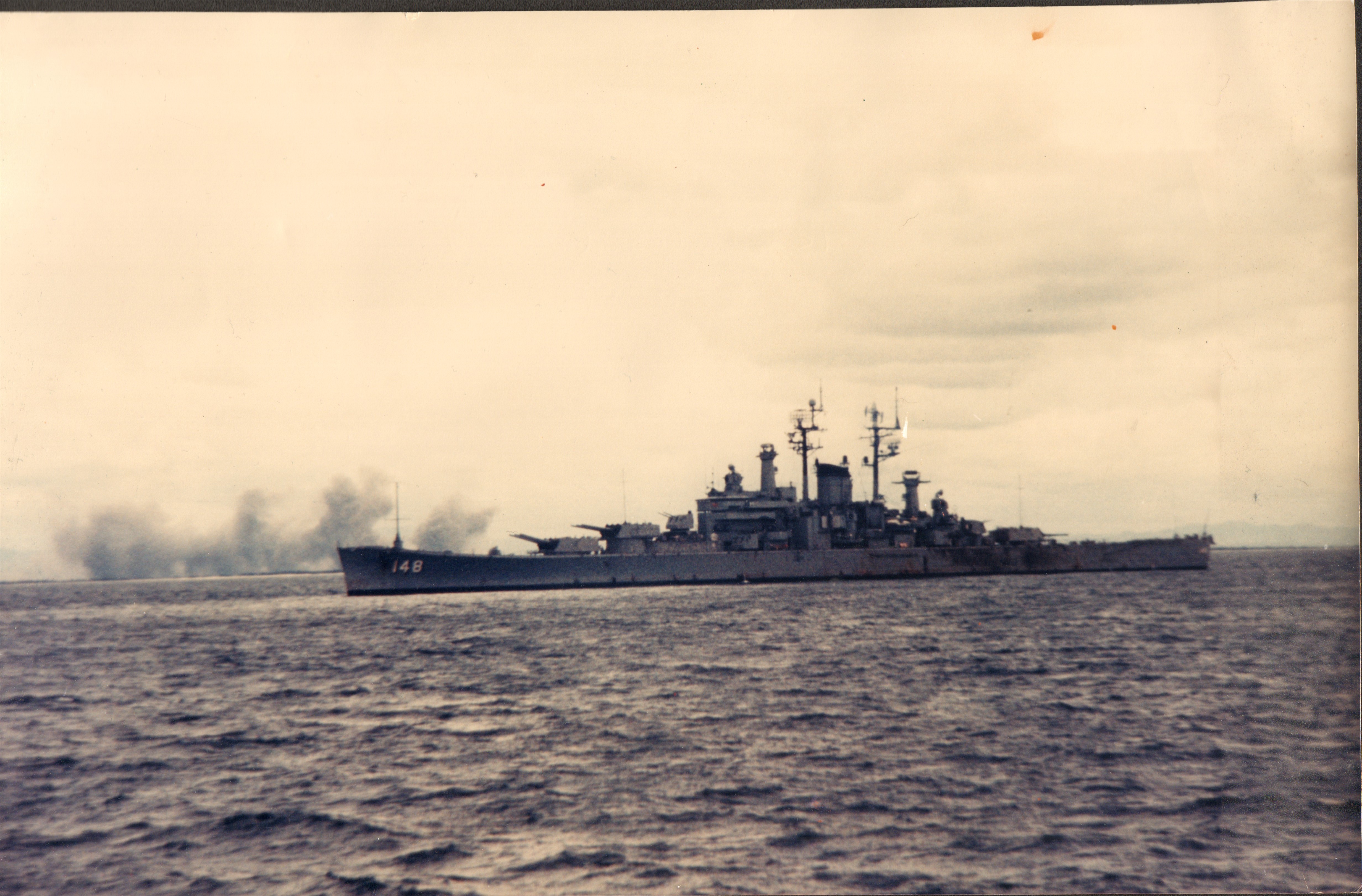
bridge going to CIC. The attached photo is of the USS Newport News (CA 48) in
the fall of 1972. The dust off its bow is an Arc Light strike. Sadly, a few
weeks later the Newport News had an in-bore explosion that killed 25 men.
(click on photo to expand)



(click each decade to view)